JOINT STATEMENT
From the International Committee for October 17 and the Irish 17 October Committee on the occasion of Ireland assuming the Presidency of the Council of the European Union, 1st July 2026
The International Committee for October 17 and the Irish 17 October Committee — the global and national bodies that promote commemoration of the United Nations International Day for the Eradication of Poverty, marked each year on 17 October — jointly welcome Ireland’s accession to the Presidency of the Council of the European Union. We wish the Irish Government every success in its leading role in EU decision-making over the coming six months, and we call on it to use the Presidency to strengthen and prioritise the EU’s commitment to eradicating poverty across all member states.
A date worth marking
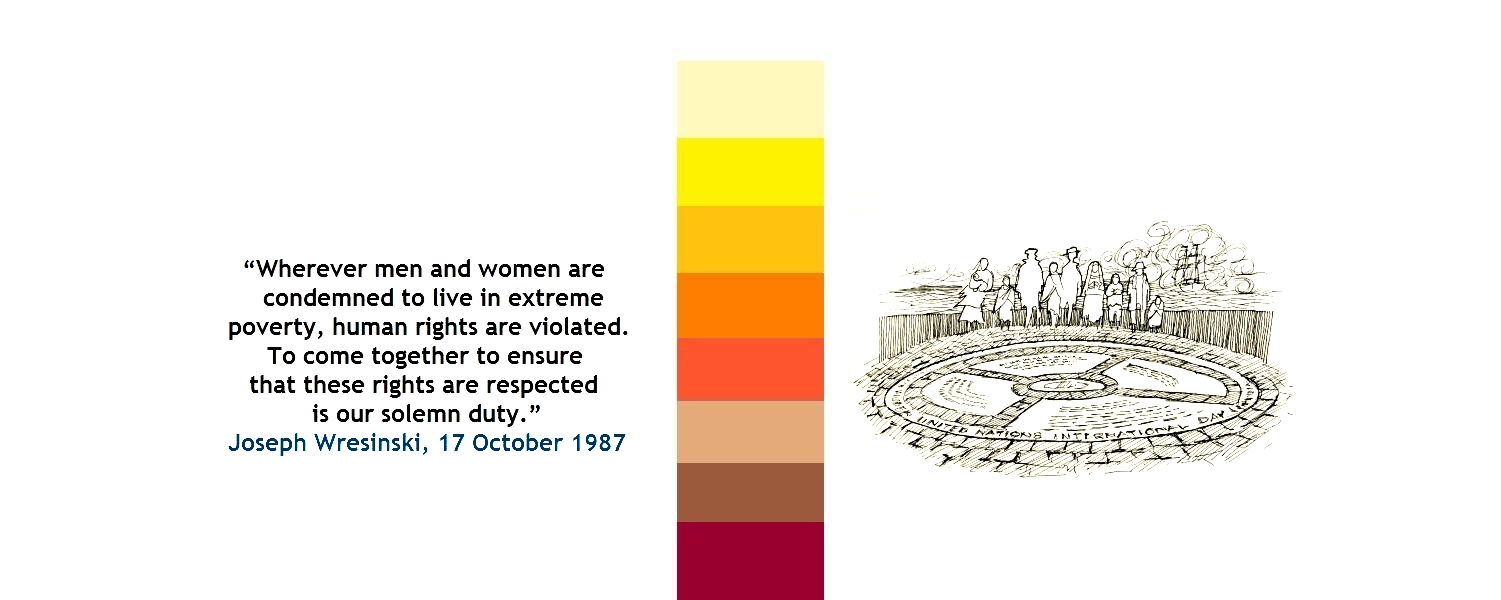
On the 17th of October each year, people gather at commemorations around the world in friendship and solidarity with those who face chronic and severe poverty, honouring their struggles and renewing a shared determination to build a world in which everyone’s human rights and dignity are respected. We ask the Irish Presidency to formally recognise the International Day for the Eradication of Poverty on the EU’s institutional calendar, giving it the standing of an official EU Presidency date.
The 2026 thematic focus of the International Day, “Safe Homes for All”, is both timely and urgent. It echoes the recent efforts of the European Commission to tackle the housing crisis, targeting first and foremost people living on low and very low incomes (see the “European Affordable Housing Plan” of December 2025 and the “Council recommendation on fighting housing exclusion” of May 2026).
Implementing the Anti-Poverty Strategy
Following the launch of the EU’s first-ever Anti-Poverty Strategy in May 2026, we urge the Irish Government to make implementation of that strategy a Presidency priority. Above all, the people who live in poverty must be central to every stage of that implementation — design, delivery and evaluation alike. As a first, concrete step, we call on the Irish Presidency to press the European Commission to honour its own commitment:
“The Commission will scale up its cooperation with people experiencing poverty. It will put in place a dedicated forum to consult them in a structured way, regularly, on the design, implementation and monitoring of initiatives aimed at combating poverty or social exclusion, as well as in other policy areas that may affect their lives.” — The European Union’s Anti-Poverty Strategy, p.19
The Villarceaux Declaration
We further call on the Irish Presidency to take careful note of last month’s Villarceaux Declaration of the International Committee for 17 October. We reiterate, in particular, its core assertions: that poverty is produced and reproduced by policy choices, unequal power relations, discriminatory norms, and institutional practices that deny people the effective enjoyment of their human rights — and that poverty can be overcome. We urge the Irish Government to draw on this declaration throughout its Presidency, and to support the implementation of all the actions it recommends (Section 14).
Thanks
Finally, we thank the Irish Government for its continued support and funding, through the Department of Social Protection, of the National Commemoration of the International Day for the Eradication of Poverty, and of the other events held across Ireland each 17 October.
_________________________________________________________________________________________________________
Attachment: Villarceaux Declaration of the International Committee for 17 October (June 2026) https://www.atd-fourthworld.org/wp-content/uploads/sites/5/2026/06/Villarceaux-communique.pdf
See also: · https://overcomingpoverty.org/international-committee-for-october-17/
· https://17october.ie/
Further information: Ger Doherty, ATD Fourth World-Ireland 086 355 2285 ger@atdireland.ie